Field guide · no affiliate links on this page
Cab Posture for the Long Haul
A ten-minute seat setup, wheel and mirror checks, and fuel-stop habits for 8–11 hour days in a Canadian cab. Updated September 2026.
Research-based. We did not test these hands-on. Scores come from published specs and driver reviews, and a product is never called tested unless it was used in a truck cab. This posture guide recommends no products and carries no affiliate links.
Key Takeaways
- Setup beats gadgets. No accessory fixes a seat that was never adjusted.
- Six checks, ten minutes. Seat height, distance, tilt, backrest, wheel reach, mirrors — once per truck.
- Move at every stop. Five moves at every fuel stop; between stops, shift your weight, drop your shoulders, and unclench your jaw about every 30 minutes.
- Winter changes the fit. A setup done in a t-shirt in September is not the setup you drive in January.
- Setup guidance only. This page is not medical advice — if something hurts or keeps hurting, talk to a clinician.
The ten-minute setup
Dial in the Seat Before the Long Day
Do this once per truck, and again whenever the season or the truck changes. Sit in it like you drive it — engine on, air seat aired up.
1. Seat height
Hips level with, or a touch above, your knees. Pump the air seat, sit down, and bounce: you should not bottom out. Low cabs and thick winter boots both eat headroom — check the roof with your toque on.
2. Seat distance
Slide the seat so you can press each pedal to the floor while keeping a slight bend in your knee. Leave two or three fingers of space between the seat edge and the backs of your knees — the edge should not press into your thighs.
3. Seat tilt
Tilt the pan just enough that your thighs rest on the cushion without pressure building behind the knees. Flat works for many drivers; the test is simple — no edge digging in after an hour.
4. Backrest angle
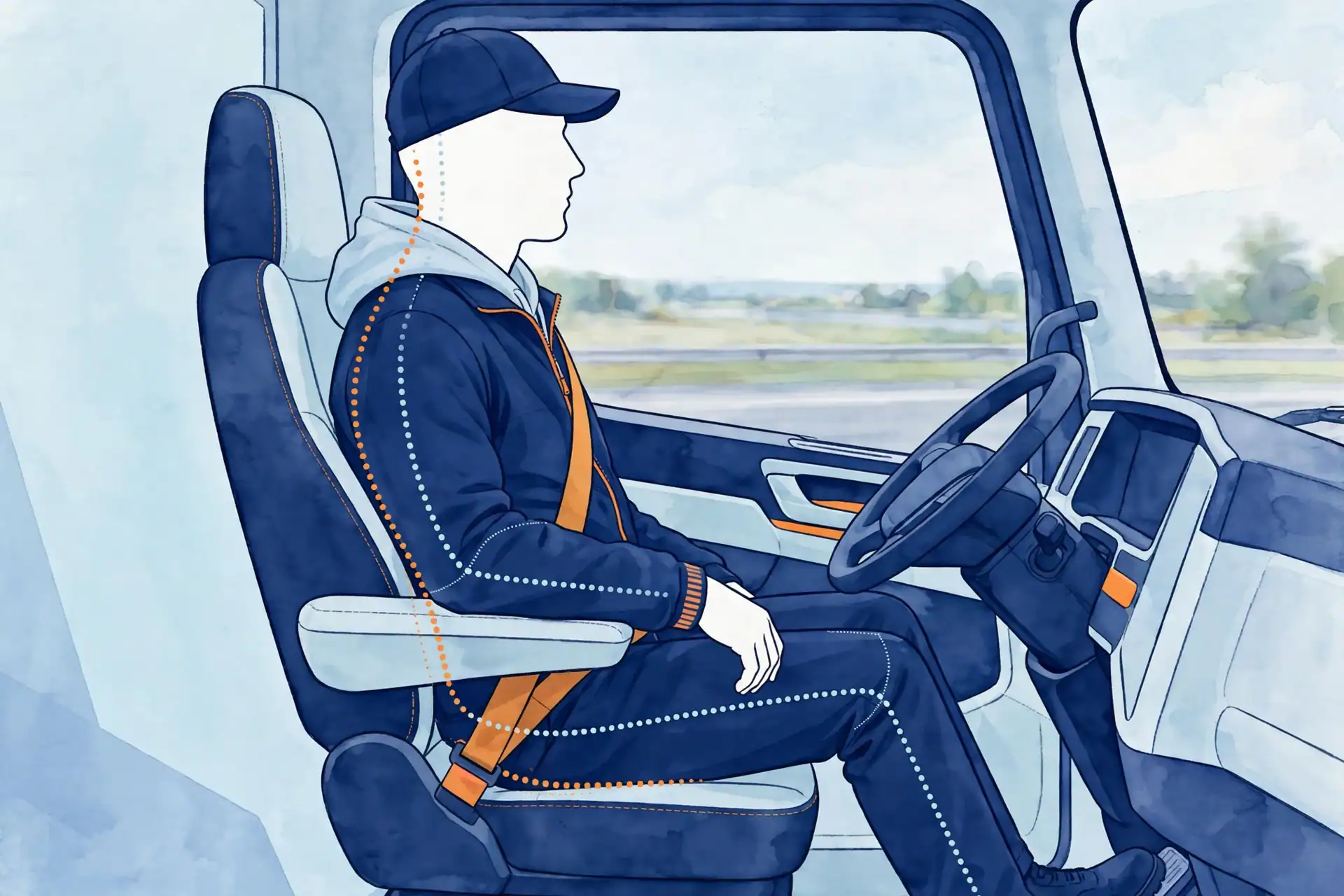
Recline a touch past upright — roughly 100 to 110 degrees from the seat pan — with your shoulders resting back instead of perched forward. Use the lumbar support if the seat has one; dial it to fill the gap, not to push.
5. Wheel reach
With your shoulders against the backrest, your wrists should rest on top of the steering wheel with a slight bend at the elbows. Bring the telescoping column to you — never lean forward to meet the wheel.
6. Mirrors
Set every mirror from your finished seated position. A glance — not a neck crane — should show the lane edge and the trailer corner on both sides. Re-do this after any seat change; a moved seat silently moves every sightline.
Fuel-stop habits
The Cab Is for Driving — Move at Every Stop
Five moves at every stop — that’s the whole habit. Between stops, shift your weight, drop your shoulders, and unclench your jaw about every 30 minutes.
Every-stop moves
- Walk the rig. Full walkaround and back — tyres, lights, straps. It breaks the sit and checks the truck.
- Two-minute stretch. Calves, chest opener, shoulder rolls. Full routine in our rest-stop stretch guide.
- Step down square. Face the cab, three points of contact — no twisted exits.
- Hips-back reset. Sit back into your ten-minute setup before you roll.
- Adjust every 30 minutes. Small seat adjustments this often — Canada’s Ergo-Tips recommend them.
Minus-40 notes
Winter Changes the Fit
A setup done in a t-shirt in September is not the setup you drive in January. Our winter cab comfort checklist covers the rest of the cold-weather setup.
1. Set up in full kit
A parka and coveralls add real bulk — they change where your back meets the backrest and how far the wheel feels. Re-do the ten-minute setup wearing everything you will actually drive in.
2. Cold starts are stiff starts
At minus-40 the cab is cold and so are you. Give the air seat a minute to come up, do your walkaround moving, and let the first few kilometres — not the first fuel stop — be your warm-up.
3. Long idles still count as sitting
Idling for heat at a January fuel stop is still eleven hours of sitting. Get out and move at every stop regardless — the walkaround does not care about the temperature.
4. Frost heaves find bad setups
Rough winter highways punish a bottomed-out air seat and a backrest you perch on instead of rest against. If the frost heaves are throwing you around, re-check height and backrest angle before blaming the road.
Leg discomfort on long sits
Sciatica on Long Drives: What Actually Helps
Setup habits drivers reach for when a long sit starts complaining. Guidance only, not treatment — if pain keeps coming back, talk to a clinician.
The wallet trick — the classic
A thick wallet in the back pocket tilts your pelvis for ten hours straight, and on driver forums this is the single most-reported free fix. Move it to a front pocket or the dash before you roll. Costs nothing, worth trying first.
Figure-four stretch at fuel stops
Cross one ankle over the opposite knee and lean forward gently from the hips. Drivers report this stretch hits the deep hip muscles that get cranky after a long sit. Do it at fuel stops, using the cab step or a guardrail to steady yourself. The full routine lives in our rest-stop stretch guide.
Cycle your seat position
One perfect position still turns into a ten-hour statue. Small adjustments about every hour — nudge the backrest angle a touch, slide an inch, then reset — keep the hips from locking into one shape. The every-stop hips-back reset in the ten-minute setup covers the rest.
Tennis ball against the seatback
A tennis ball between your lower back or hip and the seatback is a common driver trick: lean into it and roll gently, or just let it fill a gap the lumbar support misses. Drivers report it breaks up the ache on long stretches — worth trying before shopping for anything.
When to see a professional
Plain and brief: numbness that does not fade after you move, weakness in the leg or foot, or pain that keeps returning despite the setup fixes above — see a clinician. This guide can position a seat; it cannot do that job.
Neck and shoulders
Neck and Shoulder Setup: Stop Craning
Most craning is a setup problem — wheel too far, mirrors too high, seatback bolt upright. Four checks, no diagnosis needed.
Wheel distance: the wrists test
With your shoulders against the backrest, your wrists should rest on top of the steering wheel — the same wrists-over-wheel check from the ten-minute setup. Reaching forward to meet the wheel makes the head follow: neck cranes, shoulders round. Bring the telescoping column to you instead.
Mirror line: head stays neutral
Set every mirror from your finished seated position so a glance shows the lane edge and the trailer corner — no leaning, no ducking, no craning. If you catch yourself cocking your head to check a mirror, the mirror is wrong, not your head: re-adjust it.
Chin tucks at lights and fuel stops
Pull your chin straight back, like making a double chin, and hold a few seconds — drivers report it eases the forward-head ache of long highway stares. Ten slow reps at red lights, fuel islands, and loading docks costs nothing.
Recline a touch — bolt-upright is a crane
Roughly 100 to 110 degrees from the seat pan, shoulders resting back (the backrest-angle step above). Bolt-upright stacks the head forward of the shoulders; a slight recline lets the headrest and backrest do the work. If you perch on the backrest edge, your neck is doing the backrest’s job.
FAQ
Quick Answers
How often should I re-do the setup?
Every time the truck, the seat, or the season changes — and after any service work on the seat. A five-second hips-back reset at every fuel stop keeps it honest between full setups.
Will a seat cushion fix my posture?
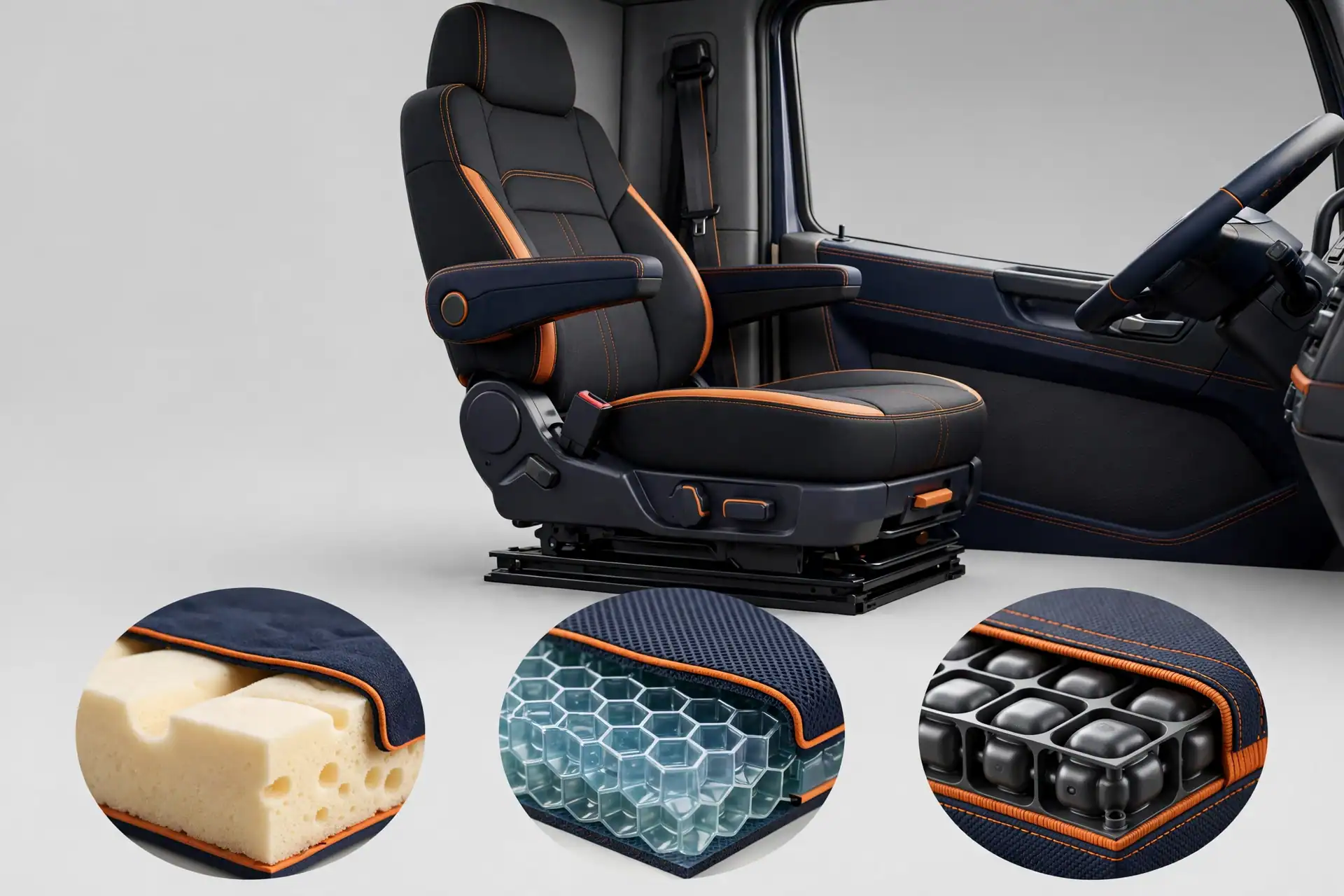
No product fixes positioning. Set the seat, wheel, and mirrors first; a cushion then supports the posture you have already built. That order is the whole point of this guide. When you do shop, pick the cushion material that suits your problem.
What about team driving or slip-seating?
Shared trucks are exactly where the ten-minute setup pays off. Run the six steps at the start of every shift — the last driver’s settings are not yours.
My truck has no lumbar adjustment. Does a rolled towel really work?
Yes — the Government of Canada’s Ergo-Tips specifically recommend a rolled towel secured to the seat at your lower back’s natural curve. Aim for gentle contact, then back off slightly; if it feels like a hard lump pushing you forward, it is too much or too high. If you would rather buy than roll, see our best lumbar supports for semi-truck seats.
How This Guide Was Made
Research-based. We did not test these hands-on. Scores come from published specs and driver reviews, and a product is never called tested unless it was used in a truck cab.
This posture guide recommends no products and carries no affiliate links. Where a cushion is mentioned, it points to the buying guide — the same scores, the same methodology, on every page.
Setup guidance only. This page describes how to position your seat, steering wheel, and mirrors, and habits to use at fuel stops. It does not diagnose, treat, or name any medical condition. If something hurts or keeps hurting, talk to a clinician — a guide cannot do that job.
Marcus Reid is a pen name. The author behind it is an Alberta-based driver who writes and scores every guide.
Keep reading
Keep Reading