Reviews · Winter
Best Portable Jump Starters for Diesel Trucks in Canada (2026)
Quick picks
Buy links are with each detailed review below — we may earn a commission at no extra cost to you. Research-based: we did not test these hands-on. Scores come from published specs and driver reviews.
Best pick
NOCO Boost Pro GB150 15/20
The highest-amp unit in this guide — 3000A peak for serious diesel cranking.
Compact pick
NOCO Boost X GBX75 14/20
Lighter, newer-line alternative with 2500A peak — serious amps in a smaller package.
No-battery backup
TOPDC heavy-duty jumper cables 12/20
1-gauge, 25 ft, 700A rated — needs a second vehicle but never runs out of charge and works at any temperature.
Short answer: the NOCO Boost Pro GB150. Diesel engines need far more cranking amps than gas cars, and the GB150’s 3000A peak is the most powerful unit in this guide. The Boost X GBX75 is the lighter compact alternative at 2500A, and TOPDC 1-gauge cables are the never-dies backup. Important: all lithium units here are 12V — many Class 8 trucks run 24V electrical systems, and a 12V jump starter cannot boost a 24V system, so check your truck’s system voltage before buying.
Research-based. We did not test these hands-on. Scores come from published specs and driver reviews. This guide contains affiliate links to Amazon.ca. As an Amazon Associate I earn from qualifying purchases. Check the live listing for the current price.

Key Takeaways
- Diesels need far more cranking amps than gas cars. A 500A car jump starter will not turn over a cold diesel — both NOCO units here are rated at 2500A peak or higher for exactly that reason.
- These are 12V units, and many Class 8 trucks run 24V. A 12V jump starter cannot boost a 24V electrical system. Check your truck’s system voltage before buying anything here.
- Store lithium jump starters in the heated cab. A lithium battery left in an unheated side box at −30°C cannot deliver its rated peak amps when you need them. Cab, not box.
- Cables are the never-dies backup. 700A-rated 1-gauge cables need a second vehicle, but they never need recharging and work at any temperature — the honest complement to any battery booster.
Why it matters
Why a Dead Diesel Ruins Your Morning
Diesel engines are high-compression machines, and cold weather hits them twice. Thick oil at −30°C resists the starter far more than warm oil does, and glow-plug preheat — the electrical cycle that warms the cylinders before cranking — draws hard on batteries that are already weakened by the cold. A gas car’s battery can be marginal and still turn over a small engine. A cold diesel with a tired battery just clicks, and then your day starts with a service call instead of a departure.
That is also why a car jump starter is the wrong tool for a diesel truck. The typical car booster in the 500A range does not have the peak amperage to push a high-compression diesel through thick oil — you need diesel-class amps, which is why the lithium units worth carrying for a diesel are rated at 2500A peak and above. It is worth reading this alongside our winter emergency gear guide — a jump starter is one piece of the cold-morning kit, not the whole kit.
The other half of the honest picture: a jump starter is a battery in a box, and batteries do not love Canadian winter. Lithium units kept in a heated cab are ready when you need them; one left in an unheated side box through a −30°C night may not deliver anything like its rated amps at 6 a.m. Plan the storage spot before you buy the unit.
What to look for
What to Look for
Peak amps, first. This is the number that matters for diesel cranking. Car boosters in the 500A range are fine for sedans and will not turn over a cold diesel — the two lithium units in this guide are rated at 2500A and 3000A peak, which is the class of amperage a diesel actually needs. Compare peak amps before anything else.
System voltage: 12V vs 24V. This is the mistake that costs drivers real money. Both jump starters in this guide are 12V units, and many Class 8 trucks run 24V electrical systems. A 12V jump starter cannot boost a 24V system — the voltages must match. Check your truck’s system voltage (look at the battery setup: batteries wired in series point to 24V) before you buy.
Cold storage and maintenance. Lithium jump starters should live in the heated cab, not in an unheated side box — at −30°C a frozen lithium cell cannot deliver its rated peak amps. Also plan to top up the charge every few months even if you never use it, and recharge it immediately after every jump.
Jumper cables as the backup plan. Cables bypass the battery-storage problem entirely: no charge to maintain, no cold-soaked cells, works at any temperature. The trade-off is needing a second vehicle and enough length to reach the batteries — which is why 1-gauge, 25-foot cables are the spec to look for. For what you can safely run off the truck’s electrical system in general, see our 12V outlet safety guide.
The picks in detail
Three Ways to Get a Dead Diesel Turning over
Scores are provisional — based on published specs and buyer reviews, not hands-on testing.
Best pick
NOCO Boost Pro GB150
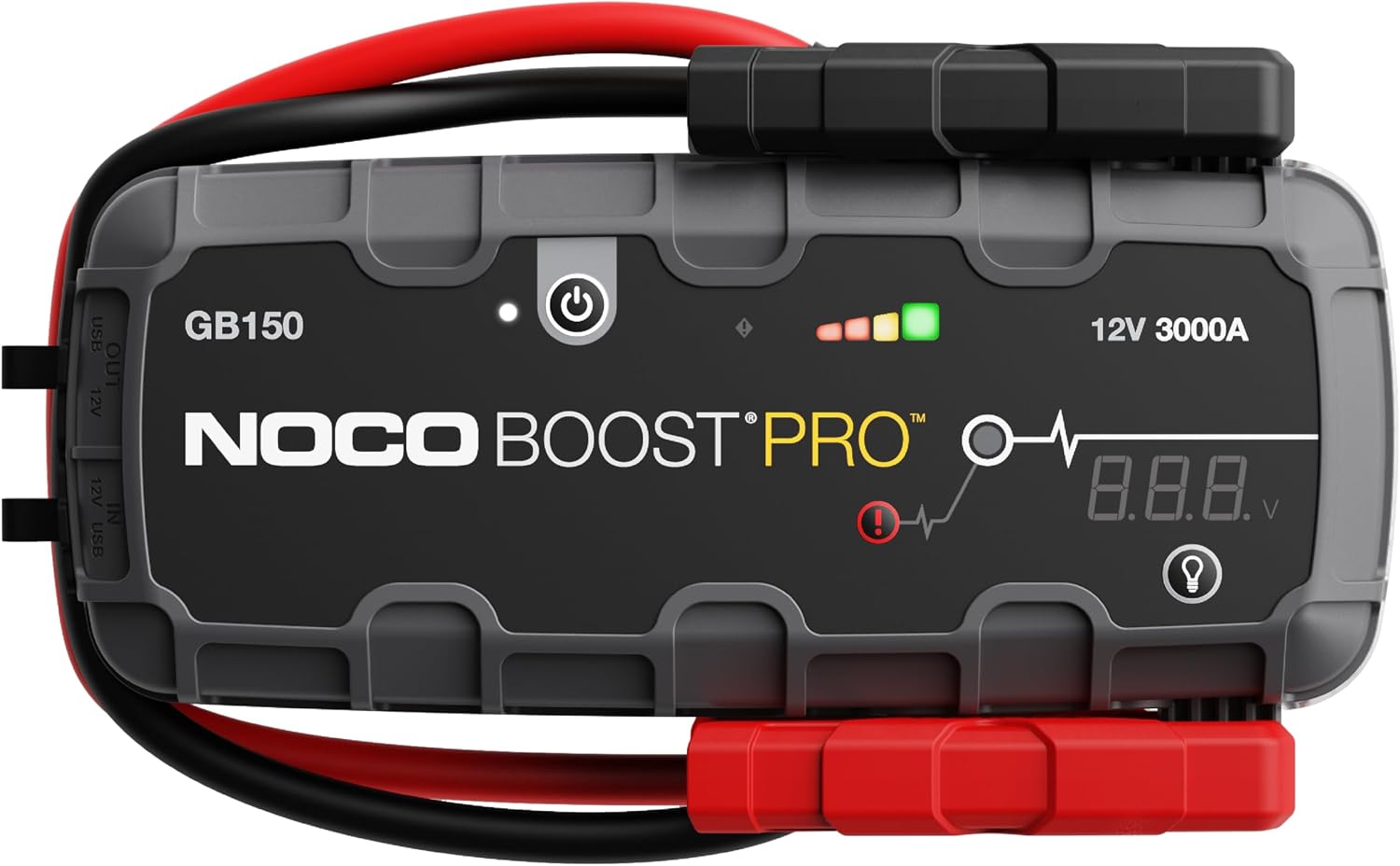
The highest-amp unit in this guide: 3000A peak from a 12V lithium booster in NOCO’s Boost Pro line, with UltraSafe spark-proof design. For diesel cranking — where raw amps are the whole game — this is the most powerful pick here.
Pros
- 3000A peak — the most cranking power of any unit in this guide.
- UltraSafe spark-proof design — connects safely without worrying about polarity.
- 12V lithium booster from NOCO’s Boost Pro line — compact next to traditional booster packs.
Cons
- 12V only — will not boost a 24V system. Check your truck’s system voltage first.
- Needs recharging and warm storage — top it up every few months and keep it in the heated cab, not an unheated side box.
- Bulky next to smaller units — high amps come in a bigger package.
- Peak amps
- 3000A
- Type
- 12V lithium jump starter
- Line
- NOCO Boost Pro
- Safety
- UltraSafe spark-proof design
- System voltage
- 12V only — will not boost 24V systems
- Storage
- Heated cab in winter — not an unheated side box
Compact pick
NOCO Boost X GBX75

The lighter, newer-line alternative: 2500A peak from a 12V lithium booster in NOCO’s Boost X line, with the same UltraSafe spark-proof design. Still diesel-class amps, in a smaller, easier-to-stash package than the GB150.
Pros
- 2500A peak — serious diesel-class cranking in a compact unit.
- Boost X line — NOCO’s newer generation, lighter and easier to store in the cab.
- UltraSafe spark-proof design for safe connections.
Cons
- Less peak amperage than the GB150 — 500A less headroom for the hardest cold starts.
- 12V only — will not boost a 24V system.
- Needs recharging and warm storage — heated cab, not an unheated side box.
- Peak amps
- 2500A
- Type
- 12V lithium jump starter
- Line
- NOCO Boost X
- Safety
- UltraSafe spark-proof design
- System voltage
- 12V only — will not boost 24V systems
- Storage
- Heated cab in winter — not an unheated side box
No-battery backup
TOPDC heavy-duty jumper cables
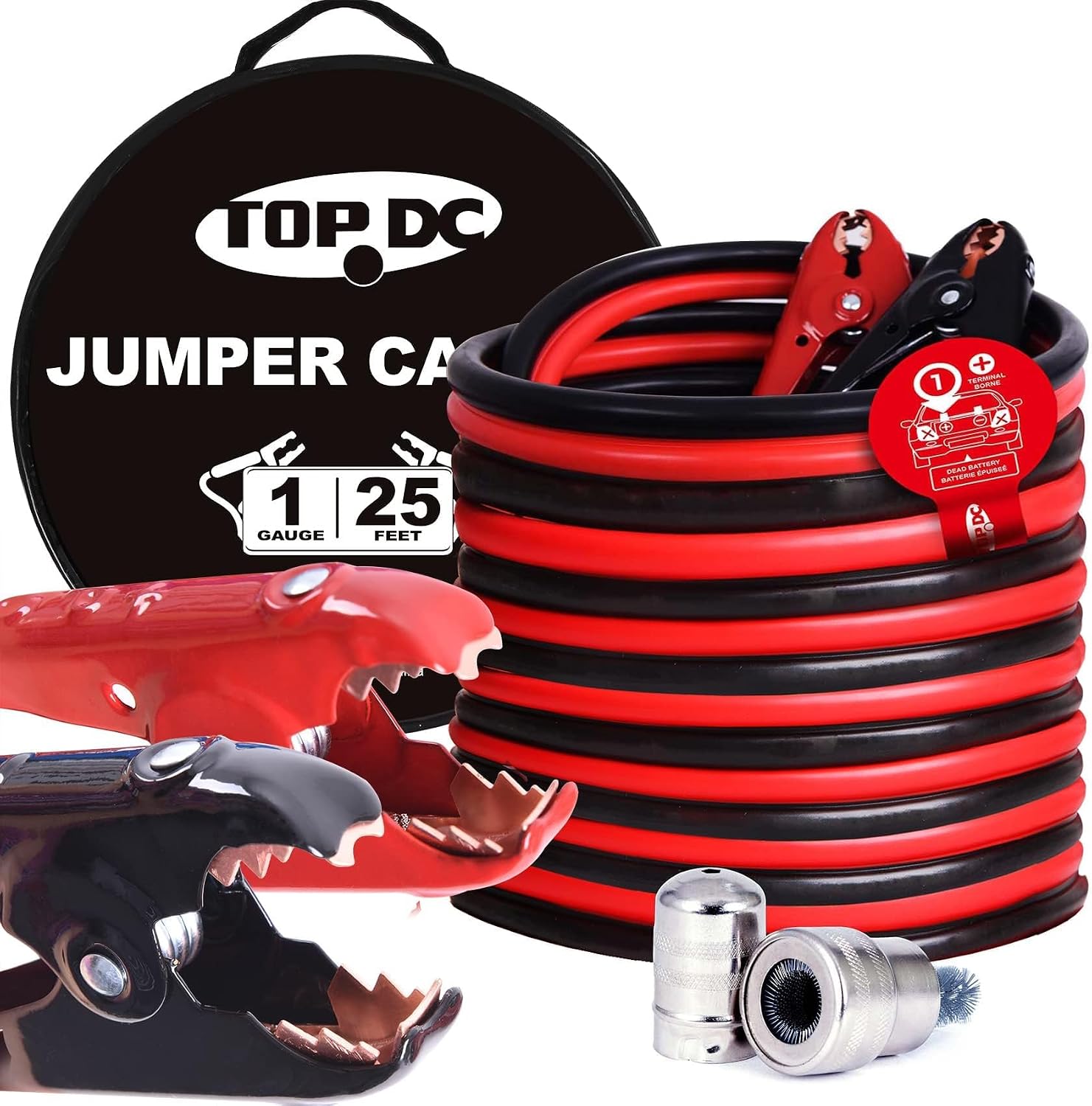
No battery to charge, no battery to freeze: 1-gauge, 25-foot cables rated 700A with heavy-duty clamps. They need a second vehicle to draw power from — but they never run out of charge and they work at any temperature.
Pros
- Never runs out of charge — no lithium cell to maintain or recharge.
- Works at any temperature — a −30°C night does nothing to a copper cable.
- 1-gauge, 25 ft, 700A rated with heavy-duty clamps — the spec class to look for in diesel-size cables.
Cons
- Needs a second vehicle — useless if you are alone in a yard at 5 a.m.
- Voltage still matters — match the donor vehicle’s system voltage to your truck.
- Bulk and weight — 25 feet of 1-gauge cable takes real storage space.
- Amperage
- 700A rated
- Gauge
- 1-gauge
- Length
- 25 ft
- Clamps
- Heavy-duty
- Cold weather
- No battery — works at any temperature
- Requires
- A second vehicle to draw power from
At a glance
Three Jump-Start Options at a Glance
| Spec | NOCO Boost Pro GB150 | NOCO Boost X GBX75 | TOPDC jumper cables |
|---|---|---|---|
| Score | 15/20 | 14/20 | 12/20 |
| Peak amps | 3000A | 2500A | 700A rated |
| Type | Lithium jump starter | Lithium jump starter | Jumper cables |
| Length / cables | Self-contained unit | Self-contained unit | 1-gauge · 25 ft |
| Cold-weather note | Store in heated cab | Store in heated cab | No battery — works at any temperature |
FAQ
Jump Starter Questions, Answered
Will a car jump starter work on my diesel truck?
Almost certainly not. A typical car jump starter in the 500A range does not have the peak amperage to turn over a high-compression diesel — especially a cold one. You need diesel-class amps: the units in this guide are rated at 2500A and 3000A peak for exactly that reason.
My truck has a 24V electrical system — will these work?
No. Both NOCO units in this guide are 12V, and a 12V jump starter cannot boost a 24V system. Many Class 8 trucks run 24V electrics, so check your truck’s system voltage before buying. Look at the battery setup: batteries wired in series point to 24V. Buy only a booster that matches your truck’s system voltage.
Can I leave a jump starter in the truck overnight in winter?
In the heated cab, yes. In an unheated side box at −30°C, no — lithium batteries cannot deliver their rated peak amps when frozen, which is exactly when you would need them most. Store the unit in the cab, and if the truck sits parked for days in deep cold, bring it inside.
How often do I need to recharge it?
Lithium jump starters self-discharge over time, so top up the charge every few months even if you never use it — and recharge immediately after every jump. The day you discover a dead booster is always the day you needed it.
Jump starter or jumper cables — which should I carry?
Honestly: both if you can. A jump starter is self-contained — no second vehicle needed — but it has a limited charge and hates deep cold. Cables never run out of charge and work at any temperature, but they are useless without a donor vehicle. The pair covers each other’s weak spots, and it fits the same winter emergency kit logic as everything else. If a bigger on-board power reserve is what you are after, our portable power station guide covers the options.
How This Guide Was Made
Research-based. We did not test these hands-on. Scores come from published specs and driver reviews.
We compared 12V portable jump starters and heavy-duty jumper cables sold on Amazon.ca using manufacturer specifications and published buyer-review aggregates as of September 2026, weighting peak amperage, diesel suitability, cold-weather practicality, and buyer evidence above price. Scores are our own, out of 20. The Amazon link shows the current price.
Keep reading