Reviews · Winter
Best Diesel Anti-Gel Additives for Winter Trucking in Canada (2026)
Quick picks
Affiliate links to Amazon.ca — we may earn a commission at no extra cost to you. Research-based: we did not test these hands-on. Scores come from published specs and driver reviews.
Best pick · Emergency rescue
Power Service Diesel 911, 80 oz 15/20
The only true rescue formula here — re-liquefies gelled fuel and de-ices frozen filters when the truck is already dead.
Best preventative
Howes Diesel Treat, 64 oz 14/20
The preventative workhorse — anti-gel plus fuel lubrication that treats up to 320 gallons per jug.
Compact pick
STA-BIL Diesel Winter, 20 oz 13/20
The compact preventative — anti-gel to −40°F in a 591 mL bottle that fits any side box.
Short answer: carry both kinds. Keep Power Service Diesel 911 in the side box for emergencies — it re-liquefies fuel that has already gelled and de-ices frozen filters. For everyday winter protection, dose the tank with Howes Diesel Treat before the cold hits. 911 is rescue, not prevention — mixing up the two is the most expensive mistake in this category.
Research-based. We did not test these hands-on. Scores come from published specs and driver reviews. This guide contains affiliate links to Amazon.ca. As an Amazon Associate I earn from qualifying purchases. Check the live listing before you buy.
Key Takeaways
- Rescue and preventative are different jobs. Diesel 911 re-liquefies gelled fuel and restores flow to a dead engine — it does not prevent gelling. Howes and STA-BIL go in the tank before the cold hits.
- Dose for your tanks, not your wish. Two 120-gallon tanks are 240 gallons of fuel: the 64 oz Howes treats up to 320 gallons, the 80 oz 911 up to 250, the 20 oz STA-BIL 150.
- Water is half the problem. Frozen filters often start as water in the fuel — Howes removes water, STA-BIL demulsifies it.
- Keep a rescue bottle on the truck all winter. Gelled fuel at −30°C on a dark shoulder is a tow-truck call — and it belongs in your winter emergency kit, not your memory.
Why it matters
Diesel Fuel Turns to Jelly in Real Cold
Diesel contains wax. As temperatures fall, those wax crystals grow, and the fuel thickens until it will not flow — first the filters clog and the engine stumbles, then nothing moves at all. The temperature where that starts is called the cloud point, and on the Prairies in January it is not a theoretical number. Winter-blend diesel from the pump helps, but a −30°C night in northern Alberta or Saskatchewan can still gel a truck that fuelled up in milder weather two provinces back.
That is why fuel treatment is not one product but two different jobs. A preventative anti-gel keeps the wax crystals small so the fuel keeps flowing — it must be in the tank before the cold arrives, ideally at every winter fill-up. A rescue formula does the opposite: it re-liquefies fuel that has already gelled and melts ice in frozen filters, getting a dead truck moving again. No single bottle does both, and treating them as interchangeable is how drivers end up pouring a preventative into a gelled tank and waiting for a miracle that never comes.
This guide keeps the two strictly separated: Howes Diesel Treat and STA-BIL Diesel Winter are preventatives, Power Service Diesel 911 is the rescue bottle. It pairs with the broader winter cab prep — fuel is only one system that fails in deep cold.
What to look for
Buy the Right Job: Rescue vs. Preventative
Know which bottle you are holding. If the label talks about re-liquefying gelled fuel or restoring flow to a stalled engine, it is a rescue formula. If it talks about preventing wax crystals, lowering the cold-filter plugging point, or winter treatment at fill-up, it is a preventative. The two are not substitutes.
Treat rate that covers your tanks. A bottle that treats 150 gallons is fine for a pickup but leaves a semi half-protected. Size the bottle to your actual fuel capacity — or carry two.
Water handling. Ice in the fuel system is a separate failure mode from wax, and it often starts as dissolved or free water in the tank. Additives that remove or demulsify water address the frozen-filter problem at its source.
Named cold numbers, when published. A published anti-gel temperature or CFPP reduction is verifiable; "winter protection" with no numbers is a claim, not a spec. Only one product here publishes its cold numbers — the honest gaps are noted below.
The picks in detail
Three Additives, Compared Honestly
Scores are provisional — based on published specs and buyer reviews, not hands-on testing.
Best pick · Emergency rescue
Power service diesel 911, 80 oz
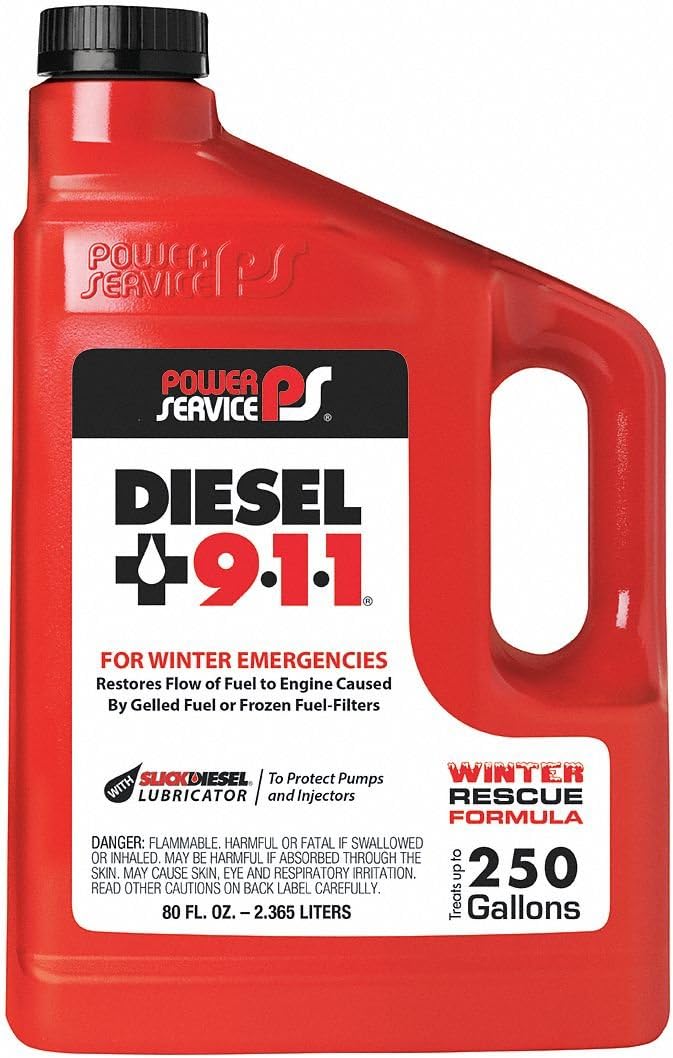
The only true rescue formula here. When wax crystals have already gelled the fuel or frozen the filters, the Winter Rescue Formula re-liquefies it and restores flow to the engine. The 80 oz red jug treats up to 250 gallons and includes Slick Diesel lubricator to protect fuel pumps and injectors while it works.
Pros
- Real rescue chemistry — label states it "Restores Flow of Fuel to Engine Caused By Gelled Fuel or Frozen Fuel-Filters."
- Treats up to 250 gallons — enough for a full semi fill from the one jug.
- Slick Diesel lubricator protects fuel pumps and injectors during the rescue.
Cons
- Does not prevent gelling — buying this as your only winter additive is the classic mistake.
- No published cold-rating numbers — rescue formulas are judged on the fix, not a temperature claim.
- 80 oz jug is bulky for a crowded side box.
- Type
- Emergency rescue — re-liquefies gelled fuel
- Size
- 80 fl oz (2.365 L)
- Treats
- Up to 250 gallons
- Lubricity
- Slick Diesel lubricator for pumps and injectors
- Prevention
- No — rescue only, not a preventative
Best preventative
Howes diesel treat, 64 oz

The preventative workhorse. A diesel anti-gel and fuel lubricant that goes in the tank before the cold hits — it prevents deposits, removes water, and treats up to 320 gallons per 64 oz jug.
Pros
- Treats up to 320 gallons — a full semi fill with room to spare.
- Anti-gel plus fuel lubrication in a single dose.
- Removes water — frozen filters often start as water in the fuel.
- Prevents deposits in the fuel system.
Cons
- No published cold-rating temperature — the honest spec gap.
- Must go in before the cold — useless once fuel has already gelled.
- 64 oz jug still takes real side-box space.
- Type
- Preventative anti-gel + fuel lubricant
- Size
- 64 fl oz (1.9 L)
- Treats
- Up to 320 gallons
- Water handling
- Removes water
- Deposits
- Prevents deposits
Compact pick
STA-BIL Diesel Winter, 20 oz

The compact preventative. Anti-gel protection down to −40°F and a −36°F cold-filter plugging point reduction, in a 591 mL bottle — with water demulsification and injector cleaning. The one that fits any side box.
Pros
- Named cold numbers — anti-gel to −40°F, lowers CFPP by −36°F.
- Water demulsification plus injector cleaning in one treatment.
- 591 mL bottle — the smallest here, easy to carry everywhere.
Cons
- Treats 150 gallons — a full semi fill needs two bottles.
- Preventative only — it will not rescue gelled fuel.
- Smallest treat rate per bottle of the three.
- Type
- Preventative anti-gel
- Size
- 20 fl oz (591 mL)
- Treats
- 150 gallons
- Cold rating
- Anti-gel to −40°F; lowers CFPP −36°F
- Water handling
- Water demulsification
- Injectors
- Cleans injectors
At a glance
Three Additives at a Glance
| Spec | Power Service 911 | Howes | STA-BIL |
|---|---|---|---|
| Score | 15/20 | 14/20 | 13/20 |
| Type | Rescue | Preventative | Preventative |
| Treats | Up to 250 gallons | Up to 320 gallons | 150 gallons |
| Size | 80 fl oz (2.365 L) | 64 fl oz (1.9 L) | 20 fl oz (591 mL) |
| Cold rating | Not published (rescue formula) | Not published | Anti-gel to −40°F · CFPP −36°F |
FAQ
Diesel Anti-Gel Questions, Answered
What is the difference between Diesel 911 and an anti-gel like Howes?
Different jobs, opposite timing. Diesel 911 is a rescue formula: it re-liquefies fuel that has already gelled and de-ices frozen fuel filters to get a dead truck moving. Howes Diesel Treat and STA-BIL Diesel Winter are preventatives: they go into the tank before the cold hits to keep wax crystals small and fuel flowing. The 911 does not prevent gelling; the preventatives cannot fix gelled fuel.
When should I add a preventative like Howes or STA-BIL?
Before the cold, at fill-up — ideally at every winter fill-up. The additive needs to mix with the fuel while the fuel is still warm and flowing; once wax crystals have formed and the fuel has gelled, a preventative cannot undo it. If you fuel in mild weather and drive into a cold snap, dose at the pump before you leave.
Will Diesel 911 fix a truck that has already gelled?
That is exactly what it is for. Per the label, it restores flow of fuel to the engine caused by gelled fuel or frozen fuel filters, and the formula includes Slick Diesel lubricator to protect the fuel pumps and injectors while it works. Follow the label directions for dosing the tank and filters, and give it time to work before cranking.
How much do I need for a semi's tanks?
Size the bottle to your fuel capacity. Two 120-gallon tanks are 240 gallons: the 80 oz Diesel 911 treats up to 250 gallons and the 64 oz Howes treats up to 320 gallons, so one jug covers a full semi fill each. The 20 oz STA-BIL treats 150 gallons — carry two for a full semi fill.
Can I use these in a pickup too?
Yes — dose by gallons treated, not by bottle. A pickup tank is a fraction of what these jugs treat, so measure out the proportional dose rather than pouring in the whole bottle. The same rescue-versus-preventative distinction applies: keep the 911 for emergencies and dose a preventative before cold weather, just like in a sleeper that sits overnight in the cold.
How This Guide Was Made
Research-based. We did not test these hands-on. Scores come from published specs and driver reviews.
We compared diesel anti-gel and rescue additives sold on Amazon.ca using manufacturer specifications and published buyer-review aggregates as of September 2026, weighting the rescue-versus-preventative distinction, treat rate, water handling, published cold ratings, and buyer evidence. Scores are our own, out of 20. The Amazon link shows the current price.
Keep reading