14/20
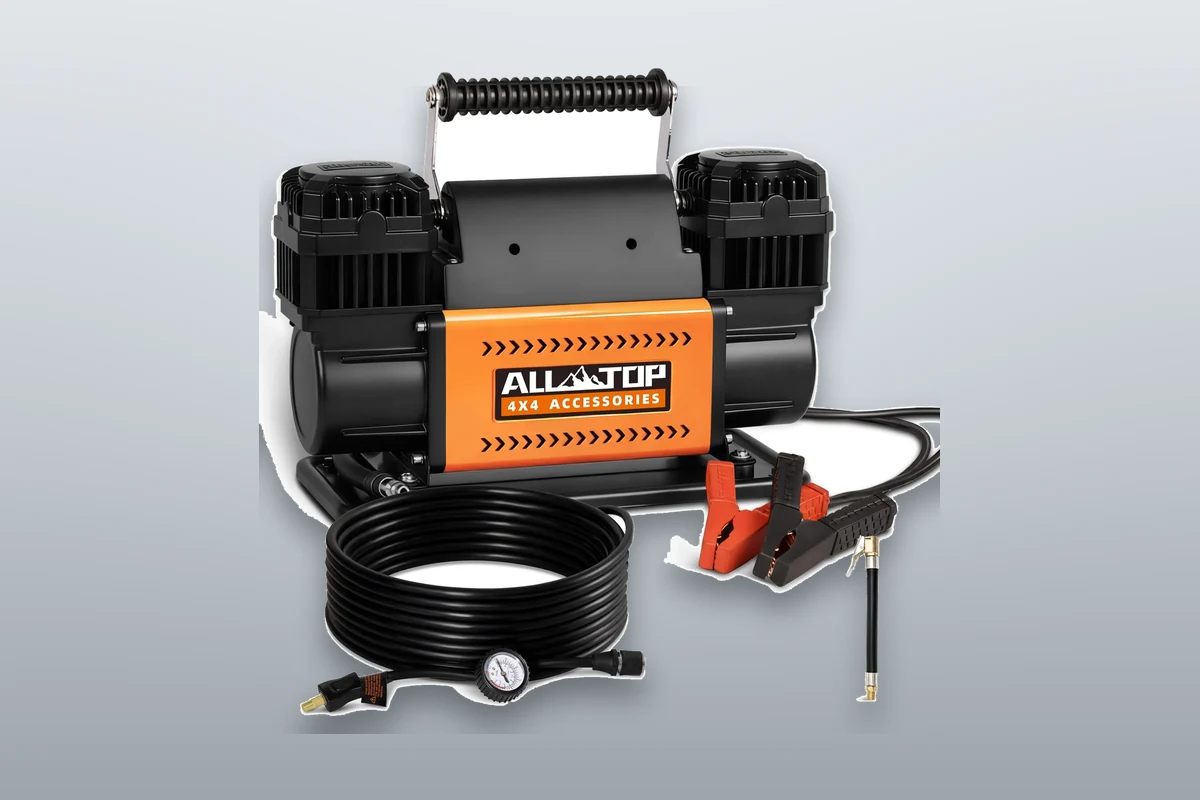
ALL-TOP dual-cylinder 12V tire inflator (14/20)
Dual cylinders for the air volume truck tires need. Fills the tire; rest it between tires.
Buying guide
Chain law, chain types, and sizing — what keeps a loaded tractor moving when the pass signs light up.
Updated October 20, 2026
Chain laws don't care about a schedule. When the sign at the bottom of the Coquihalla says chains required, the choice is chain up or park — and parking on a summit in a storm, waiting out a closure with the fuel light of the evening approaching, is the expensive option. The right chains go on fast, stay tight, and come off without a fight. The wrong set stays in the side box while the truck sits.
Research-based. These chains have not been hands-on tested yet. The guidance below comes from provincial chain law, manufacturer fitment practice, and driver experience. Ranked, scored picks land here only when real rubric scores exist — an empty winners grid is more honest than an invented one.
British Columbia runs the strictest regime in the country, and it is the one that catches out-of-province trucks every October. Commercial vehicles must carry tire chains from October 1 through April 30 on most provincial highways, and designated chain-up areas on the mountain routes — the Coquihalla (Highway 5), Highway 1 through the Fraser Canyon and Rogers Pass, Highway 3, Highway 97 north — are enforced. Enforcement officers can and do turn unchained trucks around, and during a chain-up restriction a truck without chains is a parked truck, whatever the delivery appointment says. Winter tires with the mountain-snowflake symbol are required on most BC highways over the same season for lighter vehicles; for heavy commercial trucks, carried chains are the requirement that matters.
Alberta has no blanket provincial chain-carry law, but the mountain parks add their own rules — winter tires are required on designated park roads such as the Icefields Parkway through the winter months — and a jackknifed tractor on an untreated grade answers for itself regardless of what the law said. The Prairies and Ontario lean on signage and conditions: no general carry mandate, but a chain-required or trucks-chain-up sign carries the force of law wherever it stands. Cross-border runs add the American layer: Washington's Snoqualmie Pass and Colorado's I-70 both run commercial chain laws with their own seasons and enforcement, and a Canadian tractor is held to them exactly like a local one.
The practical rule covering all of it: chains live in the truck from before the first storm until spring. Buying chains at a summit-adjacent truck stop in November, in the middle of a chain-up, is paying storm prices for whatever size happens to be left — if the size is there at all.
Ladder chains — cross chains running straight across the tread, linked to side chains — are the workhorse pattern for highway tractors. Square or twisted link, they bite on ice and packed snow, ride acceptably on the short paved stretches between chain-up areas, and are what most Canadian fleets carry. For dual drive tires the correct form is dual-coverage (triple-rail): three side chains with cross chains spanning both tires of the pair.
Cable chains trade steel links for steel cables. They are lighter and kinder to tires, and they suit passenger vehicles and light trucks. On a loaded drive axle they are out of their depth — cable stretches and fails under commercial torque and weight. Not a semi answer.
Automatic chains — systems like the air-actuated swing-arm designs that drop a spinning chain wheel against the tire from a cab switch — are fleet equipment, installed on the truck rather than carried in a box. School and municipal fleets running fixed routes love them: traction at the push of a button, no roadside stop. For an owner-operator they are an installation decision, not a purchase, and they still have limits in deep snow that draped steel does not.
Textile socks belong to the passenger-car world. They are not rated for commercial drive axles and do not meet BC's commercial chain requirement. Leave them to the SUVs.
Across every type, the tensioning system decides how the chain behaves at kilometre ten. Cam-lock tensioners built into the side chains let the driver take up slack with a tool and hold it; add-on rubber tighteners are a supplement, not a system — rubber goes stiff and brittle at −30°C, exactly when it is needed most.
Practice putting them on in the yard, not on the shoulder in a blizzard.
Chain fitment starts at the tire sidewall. The common Canadian drive sizes — 11R22.5 above all, plus 11R24.5 and the 275/80R22.5 and 445-series wide-base singles — each take their own chain size, and a chain bought for one does not stretch to another. Read the size off the tire, match it to the maker's fitment chart, and confirm the chain is the dual-coverage version for dual fitments.
Fit is a tension question, not just a coverage question. A chain that drapes on but cannot be pulled drum-tight is the wrong chain: slack becomes slap, slap becomes a broken cross chain, and a loose chain at speed flails against fenders, air lines, brake chambers, and mudflaps. The damage from ten kilometres of loose chain routinely costs more than the chains did. Wide-base single tires take their own dedicated sizes and are chained as singles — one more reason the sidewall, not the parts counter, makes the call.
Speed at the chain-up area is a skill, and it is learned in a yard in October, not on the Coq in a January whiteout with traffic sliding past. The drill:
Chains are only one leg of winter traction. Pressures matter before the chains come out — a tire set for a mild afternoon is underinflated on a −30°C morning, and the tire pressure guide covers the cold-weather math. The winter driving guide ties chains into the wider picture: corridors, closures, and when the right call is to park before the pass, not on it.
Chains die of neglect in the side box, not of work on the tire. Rinse the road salt off when the season allows, let the set dry before long storage, and hang it or bag it untangled — a rusted, knotted set takes twice as long to fit at the chain-up area, in the dark, in the storm it was bought for. Inspect cross chains after every use: one broken link found in the yard is a repair; the same link found on the summit is a second broken chain and a damaged fender. Keep a small repair kit with the set, and gloves that live with the chains rather than in the cab, so the whole system is grabbed in one motion.
No scored chain picks yet — but the pressure gear around chaining is already ranked. Airing down for traction is a guess without a gauge, and re-inflating at the other end of the pass takes real air volume:
Dual cylinders for the air volume truck tires need. Fills the tire; rest it between tires.
Traction also fails one system over: gelled fuel strands more trucks every winter than ice does. The best diesel anti-gel guide is the fuel-side companion to this one, and the full cold-weather picture lives in what freezes in a parked cab overnight and the winter gear hub.
Chain season sits inside the bigger winter system — fuel treated, batteries load-tested, heat plan working, emergency layer packed. The free Winter Cab Checklist puts the whole shutdown and start-up sequence on one phone-friendly page.
The freeze patrol, the cold-start sequence, and the layering plan on one page — free by email. Print it, screenshot it, keep it in the visor.
The signup form loads here — click once and it appears.
British Columbia is the strict one: commercial vehicles must carry tire chains from October 1 to April 30 on most provincial highways, and chain-up areas on the mountain passes are enforced — get caught without them and the truck gets turned around or parked. Other provinces lean on signage and conditions rather than a blanket carry law, but a chain-required sign anywhere is a legal order, not a suggestion.
Match the sidewall size to the chain maker's fitment chart — 11R22.5 is the most common drive size on Canadian highways, alongside 11R24.5 and wide-base singles. Dual tires need dual-coverage (triple-rail) chains sized for the pair. A chain that fits on paper but cannot be tensioned tight is the wrong chain.
Slowly. Chain makers generally cap chained speed at about 50 km/h, and less is better — speed is what breaks cross chains and turns a loose chain into a flail that chews fenders, air lines, and mudflaps. Drop off the chain-up area, find the first safe pullout, and take them off rather than running bare pavement.
Dual-coverage chains wrap both tires of a dual pair and are the standard for highway tractors — more traction, more stability, and no gap between the tires for ice to pack into. Singles on duals leave the inner tire bare and are a false economy on a loaded drive axle.
Tight enough that they cannot shift or slap. Fit them, roll a short distance — a few truck lengths — then stop and take up the slack that always appears once the chain seats. Cam-lock tensioners built into the chain hold tension better than add-on rubber tighteners, which stretch and go brittle in deep cold.
No. Textile traction socks are passenger-vehicle gear — they are not built for drive-axle torque or commercial weights, and they do not satisfy commercial chain requirements in BC. For a semi, the answer is steel: proper dual-coverage chains, carried before the season starts.
Free checklist
The 22-point run-through that catches the heater that can't keep up and the fuel that gels at 2 AM — free by email, print it and keep it in the visor.
Disclosure: The Driver Gear is reader-supported. When you buy through links on this page, we may earn an affiliate commission at no extra cost to you. Scores reflect our editorial comparison methodology — how we test.